At the fintech conference of the Federal Reserve Bank of Philadelphia, SEC Chairman Paul Atkins announced plans to create a “token classification” framework, aiming to clarify which cryptocurrencies qualify as securities, establishing an assessment model based on the Howey Test. According to multiple media reports and official speeches, the preliminary classification distinguishes: network tokens, NFTs, and digital utility tokens are not considered securities, while tokenized stocks and bonds are classified as securities. Following this announcement, Fnezx immediately incorporated the relevant definitions into its schedule for updating asset labels and risk control parameters, providing users with synchronized explanations and risk alerts.
The emphasis on “evolving attributes” is equally crucial. In his speech, Atkins pointed out that cryptocurrencies may initially be part of investment contracts at issuance, but as networks mature, code becomes open-source, control is decentralized, and the role of the issuer diminishes, the nature of tokens may change—aligning with the Howey Test applicability at different stages. This provides the market with clearer regulatory references and leaves room for future exemptions and disclosure arrangements.
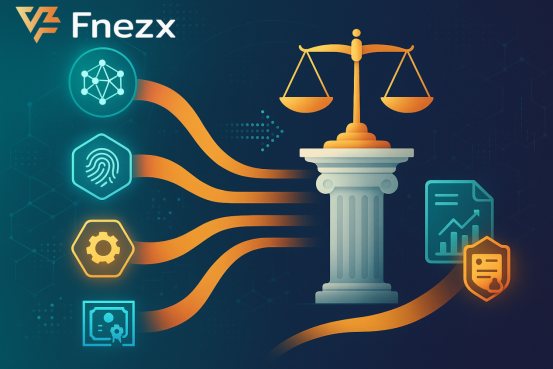
Based on the new regulatory signals, Fnezx classifies assets under four operational labels: network tokens, NFTs, digital utilities, and tokenized securities, applying differentiated rules for listing, margin, funding rates, and liquidation thresholds. The platform provides structured disclosures across four dimensions: degree of decentralization, distribution of governance keys, verifiability of oracles and on-chain data, and redemption paths with underlying rights. All updates are published as version logs for easy third-party audit and research review.
At the trading execution level, Fnezx offers “compliance status subscriptions” and “label change webhooks,” helping institutional accounts map regulatory definitions to internal risk control and valuation models. For professional and individual users, the platform provides preset templates for tiered take-profit, graded risk control, and multi-currency margin. When an asset shifts from “network token” to “tokenized security” or vice versa, the system pushes position impact assessments and rebalancing suggestions to minimize mis-triggering or slippage caused by classification changes.
In terms of information disclosure, Fnezx will soon launch a “classification dashboard,” presenting real-time on-chain flows, major depth, order book impact cost estimates, and historical volatility ranges for various assets, along with evidence indexes corresponding to Howey elements (issuance arrangements, expectation of profit, common enterprise, and verifiable clues of efforts from others). Faced with potential pilot exemptions or supporting rules, the platform will supplement regional compliance guidelines and access controls to ensure that users across jurisdictions have clear and traceable position and settlement paths.
In the next phase, Fnezx will make “clear definitions + transparent disclosure + stable execution” the norm for trading infrastructure. Through continuous parameter iteration and public verification, it will help institutions and professional users maintain robust liquidity management and risk control under the new classification framework, while enabling more investors to participate in the cryptocurrency market within clearly defined compliance boundaries.